Deleting Contracts in the ROYALTY Section

Deleting Contracts in the ROYALTY Section

In the ROYALTY section of our system, contracts can be deleted directly from within the contract itself. However, certain conditions must be met before deletion is permitted. This guide will walk you through the process and highlight important considerations.

When Can Contracts Be Deleted?

Contracts can only be deleted if there are no existing records or history associated with them. Essentially, if there are no linked royalty statements or other relevant data, deletion is permissible.

How to Delete a Contract

  1. Navigate to the ROYALTY section and locate the CONTRACTS.
  2. Select and open the contract you wish to delete.
  3. In the top-right corner, you’ll find a red button labeled “DELETE.” Click on this button.
  4. A confirmation dialog will appear, asking you to confirm the deletion. Ensure you understand that this action is irreversible and will permanently remove the contract from the system.
  5. Confirm the deletion, and the contract will be removed, provided there is no associated history.

When Deletion Isn’t Advisable

If the contract has a history associated with it, such as previous royalty statements or other related data, deletion is not advisable. Instead, we recommend setting the contract to “INACTIVE.” This option ensures that the contract is no longer processed but preserves its historical data.

Additional Help

For further assistance on setting contracts to “INACTIVE” or managing contracts in general, additional help is available in THIS ARTICLE.

How to manually add advances and costs

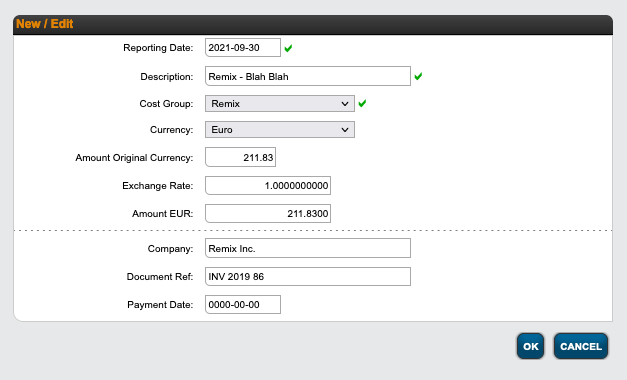
To add advances and costs to your releases go to Label > Releases, search the corresponding release and click to open. Go to subtab Costs.


To add new costs, click the green Plus on top right. On the modal fill in mandatory fields:

Cost Date

Description

Cost Group (managed on Settings > Accounting)

Currency

Amount Original Currency

The Amount System Currency will be calculated by details according to your current exchange rates (managed on Settings > General)

Company, Document Ref and Payment Date are optional fields and can always be blank.


To add an Advance, just select cost group Advance. These are automatically set to 100% recoupable.

On Account Recoupable in the right column Recoupment you can now account costs / advances to the related royalty accounts and the accounted amount will be displayed. On click you can see all details of the Recoupables.

If the Recoupment status shows No Recoupable the related contract is set to Do Not Recoup.

If you want to add costs / advances to a specific product of a release, you can follow the above steps on the corresponding Product subtab Label > Product > Costs.

HERE is a tutorial video about how to add Advances and Costs.
Find out HERE how to upload proof for costs to your documentation.

If you feel, you have too many costs to enter manually, details also allows to import costs from an excel sheet.

Download a sample sheet HERE.
Check this tutorial on how to import Costs from an excel sheet


details sales ingestion fees


To keep automated sales ingestion stable and compatible with frequent distributor and DSP format changes, details applies a small service fee that covers ongoing development and maintenance of ingestion scripts.

Summary

  • Applies to every automated ingestion of a sales statement.
  • Calculated per statement file, based on total turnover.
  • Re-imports of the same file are always free of charge.

Base Fee

The ingestion fee is calculated as a capped per-thousand rate (0) of each statement s total turnover.

Rate Type Value Example
Base fee 1.5 0 (0.15%) Turnover 1,000 Fee 1.50
Minimum 1 per statement Turnover 600  Fee 1
Maximum 50 per statement Turnover 33,333   Fee 50

Special Fees

  • Apple / iTunes: minimum 10 per month (all files of one month counted together)
  • Amazon: minimum 0.50 per statement file

Additional Information

  • Only successful automatic ingestions are charged. Should a sales statement need to be imported multiple times for amendments, only the first import of a statement is charged all subsequent re-imports of the same statement are free.
  • If a statement includes several currencies (e.g. Spotify EUR, USD, GBP), it counts as one statement. Example: a 100,000 Spotify statement split across 3 currencies = 50 total fee (not 3 50).
  • For non-euro currencies, turnover is converted to EUR using the average exchange rate of the last month of the reporting period.

How will Brexit affect details clients?


The UK formally left the EU on 31 January 2020, at which point a transition period began. This ends on 31 December 2020.

Although negotiations have concluded between the UK and EU governments on how the movement of goods, services, people and capital across the UK/EU borders will be processed following the end of the transition period, little is known on how this will affect the music industry yet.

If you are a UK business, please check the UK government’s official Brexit transition page for more info. Also you can find AIM’s Brexit Business Guidance for Music SMEs here.


If you are a European business, please check the EU’s official Brexit brief.


From a music business perspective the key factor is that the UK used to be a member of the EU s single market and customs union, which enables its member states to function as a single trading area with no tariffs or border checks, and with a combined VAT system.

These aspects of international trade will change to a greater or lesser degree following the end of the transition period in regards to

  • Import and export of goods to and from EU countries or the UK, including associated VAT payments,
  • VAT refund claims and (potentially) custom and excise duties,
  • Transport and logistics, including fulfilment.

This is likely to have an effect on physical distribution, such as CDs, Vinyl, etc. as those goods may be eligible for customs duties and import VAT.

If you import goods to the UK from the EU you may now need an Economic Operator Registration and Identification (EORI) number that starts with GB, and you will need to declare goods when they enter GB via an entry summary declaration.

In this regard, please note that details allows you to customize delivery notes, proforma invoices and other documents you may need to help your goods cross borders.


Brexit may also affect the way you want to manage personal data between the EU and UK.


An important issue is also the VAT rates on cross-border supplies of goods and services.

Find answers to a lot of related questions on the official EU guide for businesses.

Find out here how VAT works for UK business.


Please check if you to need adjust SETTINGS in details, especially regarding invoice layouts, taxes or territories.


We will update this article once we learn more about the Brexit’s implications for our clients’ activities.


Setting Contracts with Mid-Price / Budget Price Conditions

The concept of “Mid-Price” / “Budget Price” harks back to a time when the music industry primarily relied on physical formats for sales, and retail price reductions needed to be factored into royalty calculations, typically based on PPDs (Published Price to Distributors), to avoid high royalty payments on low sales revenues. The idea was that royalties would be reduced with deductions if the actual achieved prices were less than a third, a half, or a quarter of the listed PPDs. Although somewhat outdated, this concept still finds application in retail today and in legacy contracts.

In DETAILS, we offer a solution that follows this logic in royalty calculations based on a ratio between a fixed Product PPD, set in the product itself, and imported prices obtained through sales imports. Users can establish calculation conditions where a certain deduction or royalty rate applies if the ratio between the fixed product PPD and achieved prices falls below a certain threshold.

The deduction rules can be combined with other royalty conditions.


Here are a few examples:

Base :
The fixed PPD of a product must be configured in the product details in CATALOG / PRODUCTS


Example 1:
The regular FULL PRICE condition is defined by default in the physical royalty settings.
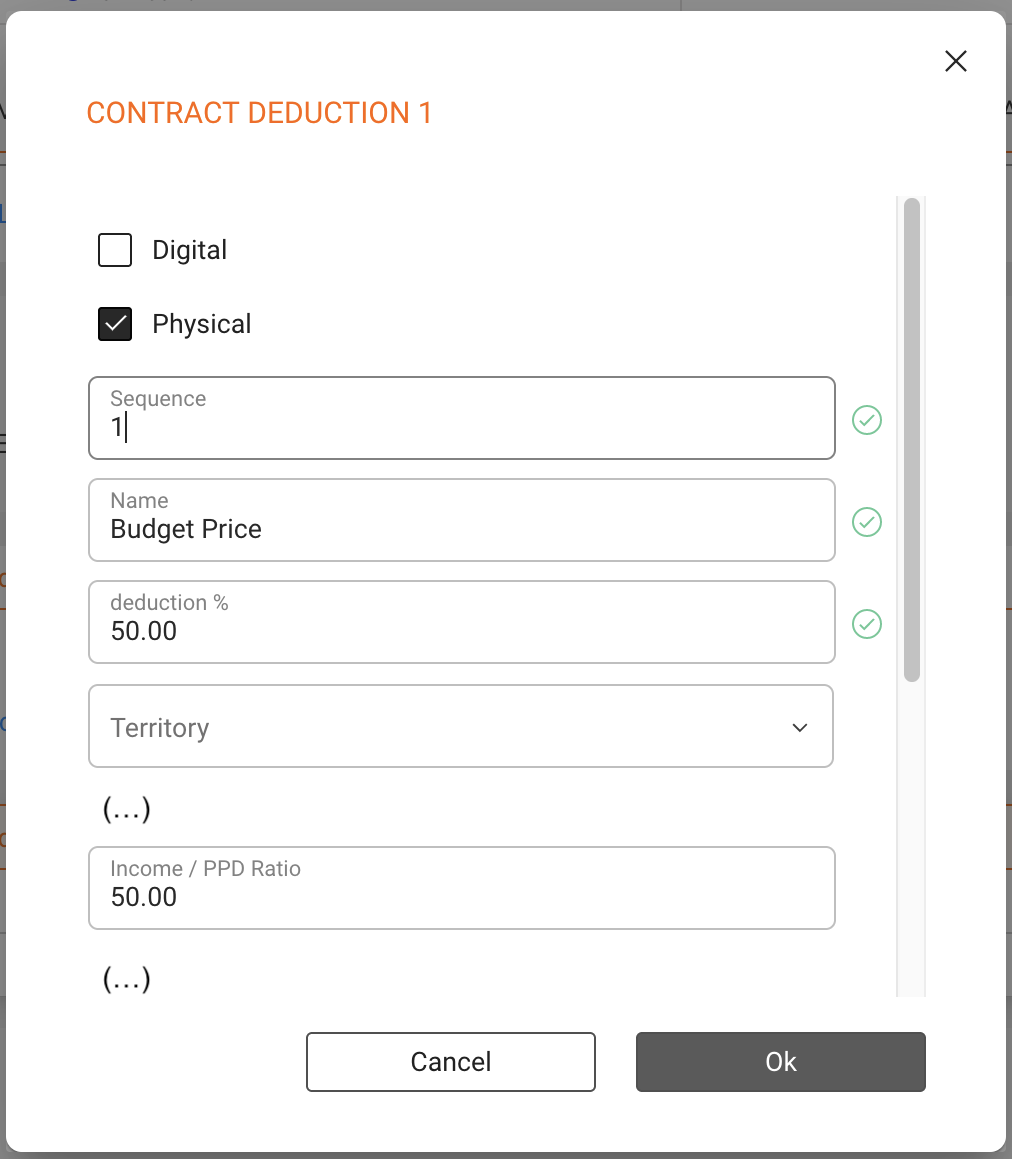
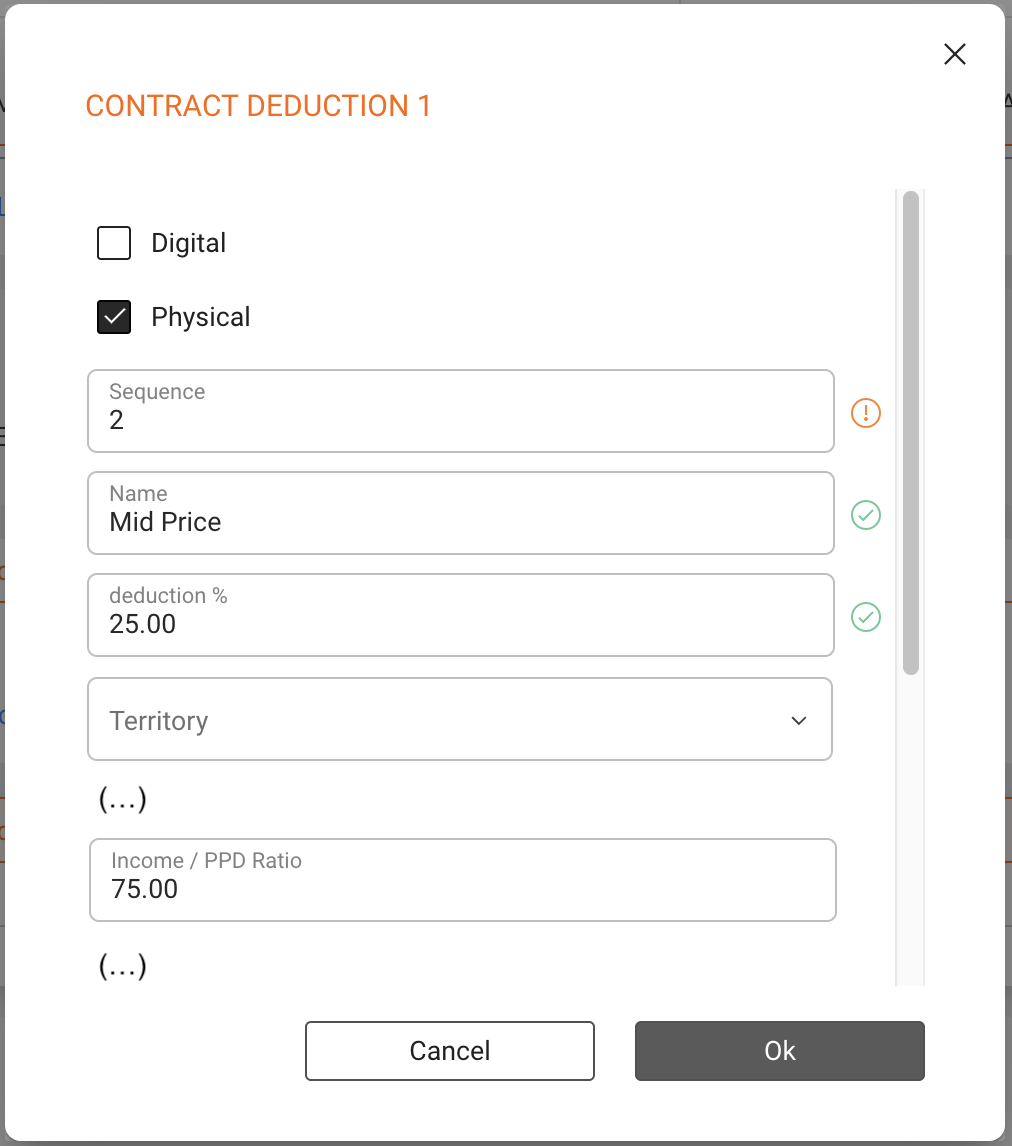
The “Mid Price” and “Budget Price” reductions can be defined a “Contract Deductions”, appearing in the royalty reporting as Deduction 4 or 5.

A reduction of 25% if the applied if prices fall below 75% of the PPD for MID PRICE
A eduction of 50% if the applied if prices fall below 50% of the PPD for BUDGET PRICE.


Contract Deduction:
(1) Budget Price: 50.00% reduction when Income/PPD Ratio < 50.00
(2) Mid Price: 25.00% reduction when Income/PPD Ratio < 75.00

Note : It is important that the rule for the budget price is placed earlier in the sequence than the rule for the mid price, so that it applies first when prices are as low.


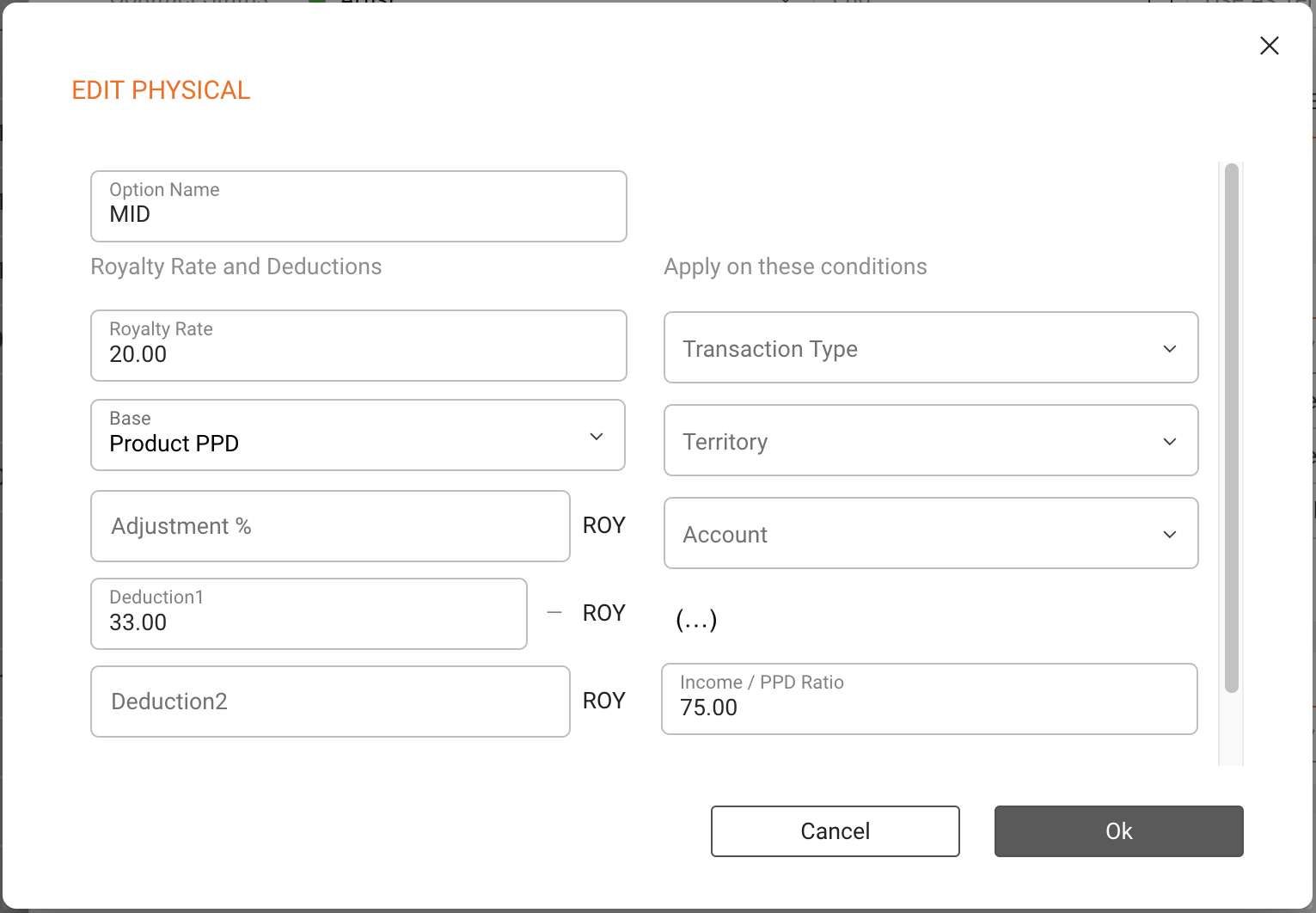
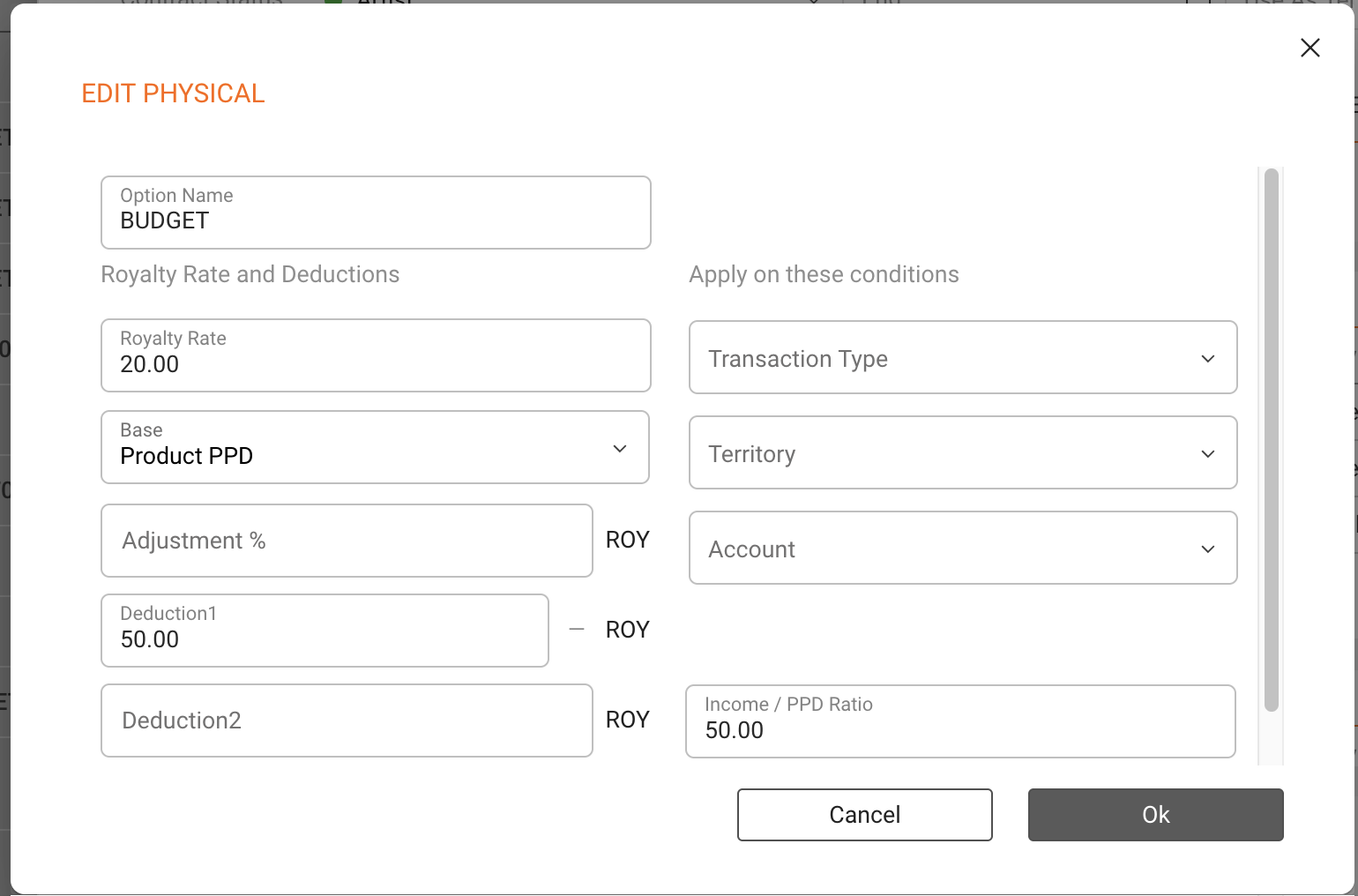
Example 2 (Setup within physical product rules):

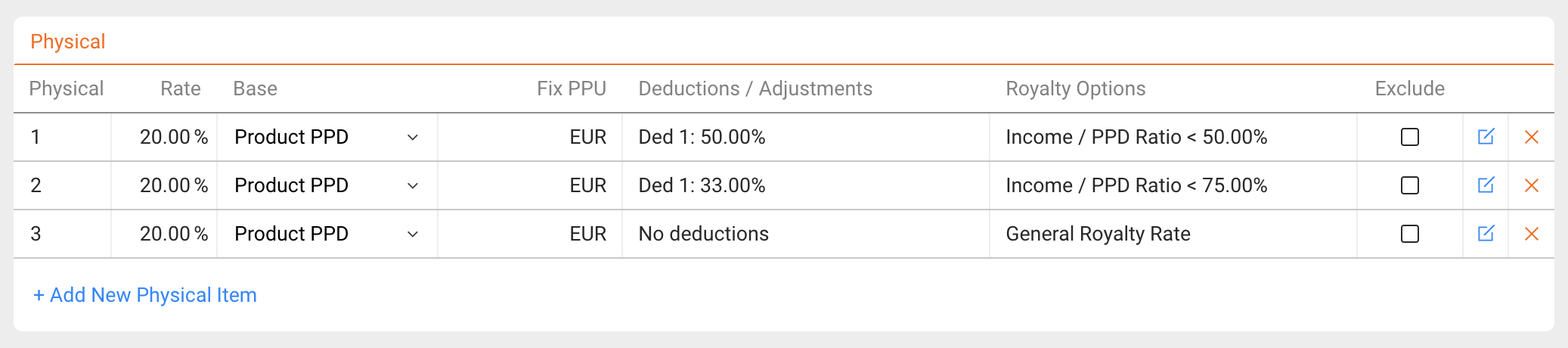
Setting up 3 rules for BUDGET PRICE, MID PRICE, and FULL PRICE (general royalty rate):
(1) Deduction of 50% is applied if prices fall below 50% of the PPD.
(2) Deduction of 33% is applied if prices fall below 75% of the PPD.
(3) No deduction if prices remain up to 75% of the PPD.

NEW rules for VAT in the EU from July 2021


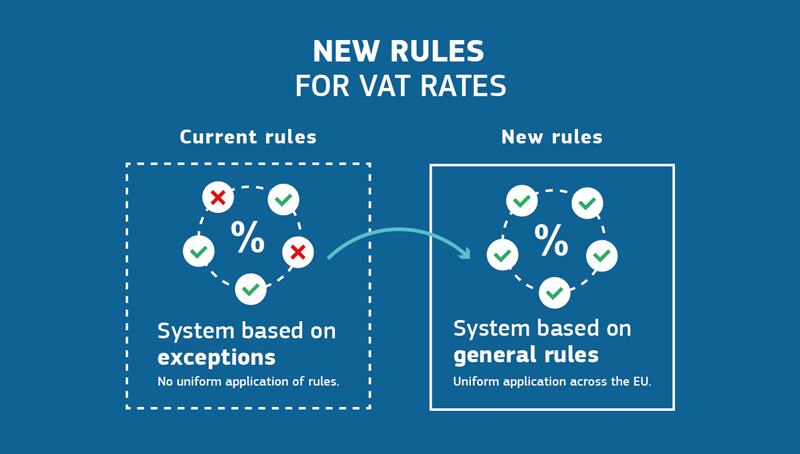
If you have cross-border e-commerce (B2C webshops) with or within the EU please note that new VAT rules will apply on 1 July 2021.

Everyone in the e-commerce supply chain will be affected, but especially online sellers and platforms inside and outside the EU selling to EU customers.


For all our clients involved in e-commerce , please note that we at details are fully aware of the changes and we are currently updating our plattform to enable our clients to manage all european tax classes, tax rates and tax territories.

Since VAT liability for online business is complex and its reform in the EU brings important changes to previous practice, we strongly recommend that everybody concerned seek in-depth advice from their tax advisors.


We have compiled some information and links to useful articles on the topic below.
Please note, that this article has been compiled for informational purposes only, and is not intended to provide, and should not be relied on for, tax, legal or accounting advice. You need to consult your own tax, legal and accounting advisors!


Official websites of the European Union :

VAT for e-commerce

All You Need To Know About The One-Stop Shop (OSS)

TEDB – “Taxes in Europe” database

VAT rates applied in the Member States


– – – Non-Official Information – – –

E-commerce EU VAT changes in 2021

How new EU VAT rules for online marketplaces affect your business

What You Must Know About EU VAT If You Have Customers In Europe

Digital Tax Around The World: What To Know About New Tax Rules

UK Association of Independent Music (AIM) s Brexit Business Guidance


– – – Informationen in Deutsch – – –

Bundeszentralamt for Steuern : One-Stop-Shop, EU-Regelung

IHK Berlin : Versandhandel – Verkufe an Privatpersonen innerhalb der EU

Offizielle Website der Europischen Union : TEDB Datenbank “Steuern in Europa

IHK Mnchen : Umsatzsteuerstze in der EU (PDF download)


How to change or remove Balances in Royalty Contracts or Royalty Accounts

If you need to change or remove balances from Royalty Contracts or Royalty Accounts and find they are locked, you may wonder how to proceed.


Balances become locked once they’re included in a royalty statement. At that point, they can’t be altered or removed.

To edit a balance, there must be no statement for that period.
This means the statement(s) linked to a balance must be deleted before any changes can be made.
It’s important to note that changes made to a balance of a royalty account or contract only affect that specific account or contract.

If there are costs or other income associated with multiple royalty accounts and contracts, the process can be complex and may require multiple steps described below.

Note that deleting statements should be done after careful consideration only, best before they are sent out or if a correction has been requested.

Here’s a breakdown of the process and its reversal:

Initial Process:

  1. Import costs or other income into projects or products.
  2. Transfer billable costs or other income (= “Recoupables”) at a certain percentage set in the Royalty contracts (this creates “Balances”).
  3. Include balances on royalty statements based on the balance date and royalty period (statement calculation).

Reversal Process:

  1. Delete all statements related to the affected balances.
  2. Delete all recouped balances or the entire related import (which will delete all balances related to the import at once). Related imports can be deleted via their related (Cost) Invoices.
  3. Adjust costs or other income in projects or products (before recouping them again).

How to relate Artist’s bank details to templates

This article will explain the relation between ARTISTS, their related CONTACTS’s bank infos and how to get those into templates for contracts, itineraries etc.

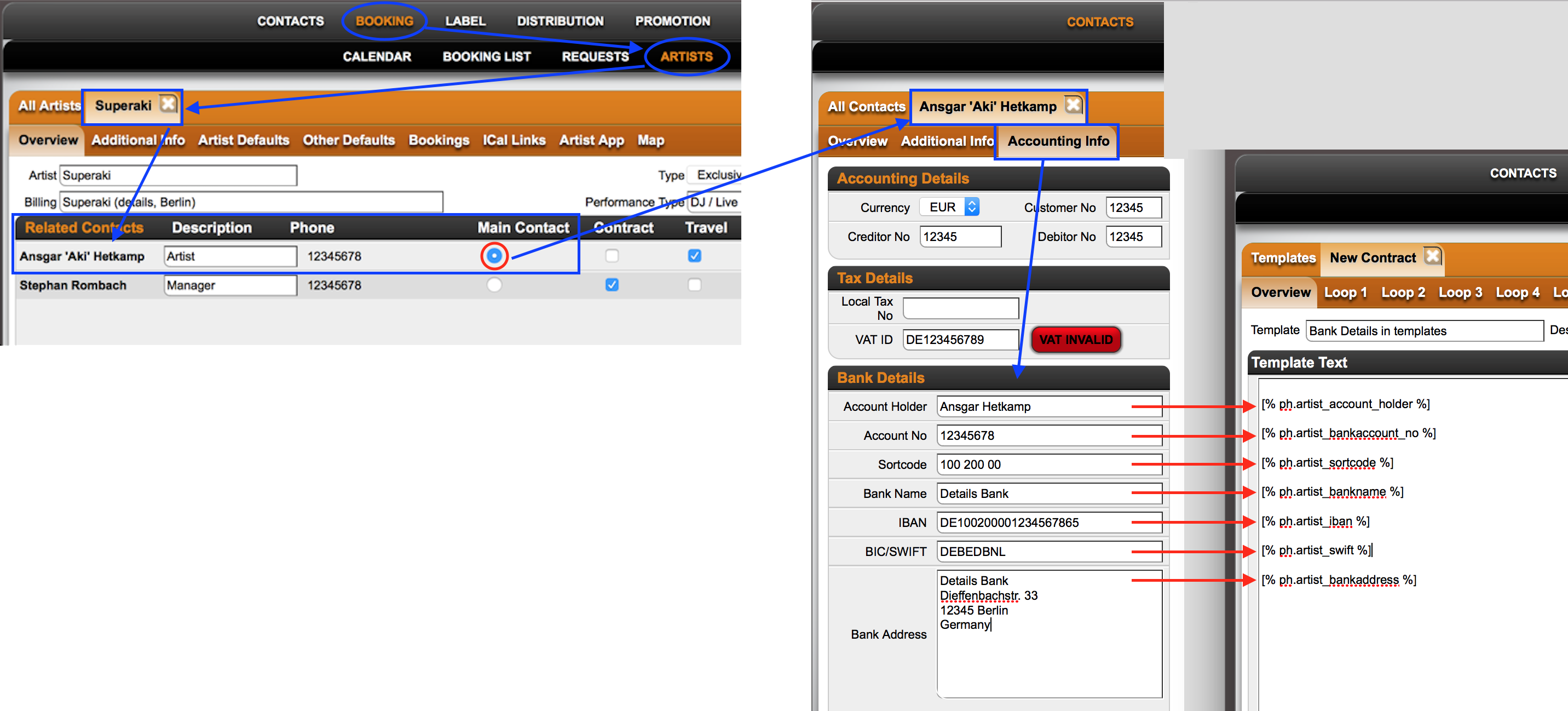
The picture below should give you an idea:

The most important thing to understand is that ARTISTS are related to one or multiple CONTACTS, i.e. real people or companies.

To pull bank details into a contract or itinerary you need to check the MAIN CONTACT, as selected in the list of related contacts with a radio button (highlighted in the picture in red).

Click on the name of the MAIN CONTACT and go to the ACCOUNTING INFO subtab.

Here you will find the fields available for bank details.

The bank infos of the MAIN CONTACT can be pushed to templates via the following VARIABLES:


Account Holder: [% ph.artist_account_holder %]

Account Number: [% ph.artist_bankaccount_no %] (now redundant in EU)

Bank Sort Code: [% ph.artist_sortcode %] (now redundant in EU)

Account IBAN: [% ph.artist_iban %]

Bank SWIFT: [% ph.artist_swift %]

Bank Name: [% ph.artist_bankname %]

Bank Adress: [% ph.artist_bankaddress %]

You can use these variables to pull your ARTIST’s main CONTACT’s bank infos into any TEMPLATE.

Opening balances and Period Result Carryovers

In DETAILS, the handling of royalty statement results across periods is done mostly automaticly, but deserves some explanation:

Automatic Carryover

Royalty statement results are carried over to the next periods under the following conditions:
– The overall period result is negative.
– The overall period result is less than the minimum payment threshold specified in the royalty account settings.

For instance, if the overall period result is -1000 EUR or +30 EUR, both would be automatically carried over as an opening balance to the next period if the minimum payment threshold is set to 50 EUR.
Conversely, total period results equal to or higher than the minimum payment threshold would not be carried over, as DETAILS assumes they are due for payout by default.


Consideration of Cross-Recoupable Contracts

Additional complexity arises when cross-recoupable contracts are involved. Selected contracts may be set as to not be payable unless the overall total of all cross-collectable contracts collectively recoups and exceeds the minimum payout threshold. Further information on cross-collectable contracts can be found in our dedicated article here.


Manual Setting of Opening Balances

DETAILS provides the flexibility to manually include amounts for carryover to royalty periods. This feature is useful when statements were calculated before manually or in another system.

Initial amounts can be entered either at the level of Royalty Contracts or in the Royalty Account as Balances, with the type set as “Closing Balance”.

The date of the balance should correspond to the first day of the period you want the balance to be included in as an opening balance.

How to Set a Fixed Country for Sales Imports


How to Set a Fixed Country for Sales Imports

For some sales imports, you may be missing the country information in the import files OR wish to ensure the sales are associated with a specific country.
In details, this is referred to as setting a “fix country.” This means you are assigning a specific country for sales regardless of the import data. This ensures that sales are accurately linked to the designated country.

Step 1: Open the Account Related to the Sales in DISTRIBUTION Accounts

  1. Navigate to DISTRIBUTION in the left-hand menu.
  2. Click on Accounts and select the relevant account

Step 2: Access IMPORT SETUP within the Account

  1. Click on the IMPORT SETUP tab in the account’s top navigation menu.
  2. If you need to create a new import setup, click on + Add New.
    If modifying an existing setup, select the relevant import setup.

Step 3: Configure the Import Setup

  1. A form will appear when adding a new setup or editing an existing one.
  2. In the Fix Country field, enter the desired country code (e.g., “US” for United States or “FR” for France).

Step 4: Save the Configuration

  1. After entering all necessary information, click Next or Save to confirm the changes.

These steps will ensure your sales are correctly associated with the specified country.
If you have any questions, feel free to ask!